Former Music Master’s transfiguration
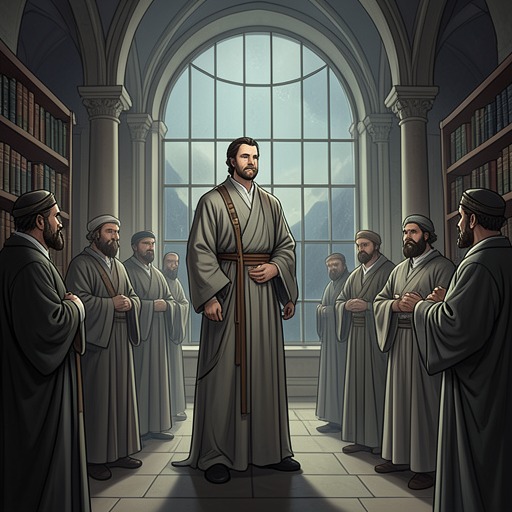
The Glass Bead GameThe former Music Master’s transfiguration is the late-life transformation through which a life devoted to music seems to gather into silence, serenity, and radiance. Joseph Knecht first approaches it as a friend anxious to visit an old teacher before death; he leaves understanding the visit instead as a rare encounter with a different mode of being, one that music and contemplative attention can suggest but words cannot fully explain.
Withdrawal from Speech and the World
For several months, the former Music Master had spoken less and less. His secretary, Petrus, initially wondered whether he could hear properly or sustain his attention, but tests showed that his hearing remained nearly as good as before. The change seemed deeper than failing faculties: he appeared increasingly to inhabit a world of his own, rather than to live fully among those around him. He seldom visited or summoned anyone, and could pass days seeing no one but Petrus. Although he did not seem near death, Petrus believed that it was important for Knecht, his former pupil and old friend, to visit before the Master’s interest in visitors diminished further.
Knecht rearranged his official duties and travelled to Monteport with Petrus. At the garden pavilion where the old man lived, they waited outside while he finished a delicate, restrained but rhythmically assured duet, played with two fingers. The music offered a first measure of the change: the Master’s diminished speech did not mean an absence of life or expression. His silence belonged to an existence increasingly turned away from words and toward music.
Knecht’s Encounter at Monteport
The face that welcomed Knecht was recognizably the same one he had known for nearly thirty years. The Master’s voice had softened, his hair had gone white, his handshake had weakened, and his movements had lost some of their former suppleness; yet his smile retained its brightness and depth. This time, however, Knecht perceived something altered within that familiar expression. The radiance had become more intense and mysterious, at once continuous with the old Master and unlike anything Knecht had previously seen in him.
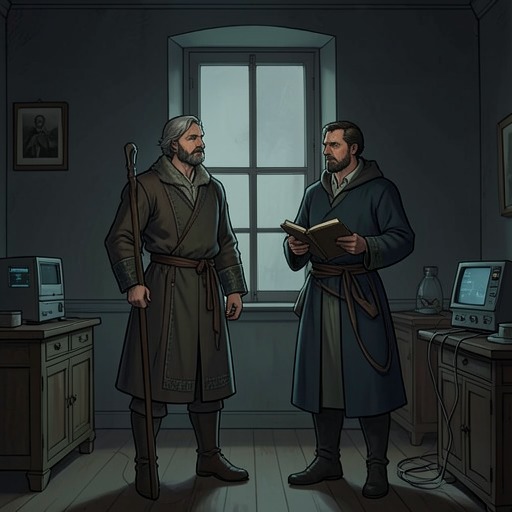
After the visit, Knecht described the encounter to his friend Carlo Ferromonte, a librarian at Monteport’s music library. At first, he had expected little beyond the chance to see the old man again. The Master greeted him by name, then sent Petrus away with a look. Knecht tried to converse, asking questions and telling him things; the Master answered with glances and a smile. The silence left Knecht feeling importunate and worn out, as if everything he said belonged to a world that could not reach the man before him.
The silence did not simply dismiss Knecht. He came to understand that it reproved his effort to force an ordinary conversation, though on a different plane from mockery or spoken rebuke. At last the Master spoke a few words, reminding Knecht that he was tiring himself, and lightly touched his arm. That small intervention changed the encounter. Knecht stopped straining to question or interpret the old man and let the visit take its own course. The Master’s patience and calm then became intelligible to him, not as a refusal of friendship but as an invitation to share in a peace that speech could not produce.
Music as a Form of Transformation
Knecht understood the Master’s direction as a movement away from people and words, and away from ideas toward unity. He experienced the old man’s life as one of devotion and work, free from ambition and obstruction, shaped throughout by music. In his account to Ferromonte, becoming a musician and then Music Master seemed to have been the Master’s chosen path toward inner freedom, purity, and perfection.
That transformation, as Knecht imagined it, had reached beyond professional skill. The Master’s nimble pianist’s hands and extensive musical memory were only part of it; music seemed to have permeated his whole person, down to bodily rhythms, breathing, sleep, and dreams. Knecht therefore called him not merely a symbol but a manifestation of music. What passed between the two men during their silent hour felt to Knecht like immaterial music: a living, shared rhythm that absorbed him as a voice enters a song sung by many.
Knecht allowed that another observer might have perceived the same grace in another image. An astronomer might have imagined a moon circling a planet, while a philologist might have heard a primal language containing all meanings. These comparisons do not settle what the transformation is. They show instead how its experience exceeds a single explanatory vocabulary, while Knecht’s own perception remains decisively musical.
Naming the State and Preserving the Account
Ferromonte was reluctant to turn the experience into a religious label. As a musician and historian, he wanted to classify it not to diminish its beauty but to describe it precisely and preserve what had been witnessed. He accepted that Knecht and others had encountered a serenity that deserved attention, while questioning whether the word saint properly applied in a community that was neither a Christian congregation nor a Hindu or Taoist monastery.
Knecht did not ask Ferromonte to begin a process of canonization. He left him free to name the old Master’s state, suggesting terms such as grace, perfection, or the wisdom of age. Though the Castalians had neither denominations nor churches, Knecht argued that piety was not foreign to them, and that a life of music and devotion could bear a resemblance to accounts of perfected or transfigured souls in other traditions. The tension between Ferromonte’s impulse to classify and Knecht’s willingness to describe an experience that exceeded categories becomes part of the episode’s meaning: careful attention can preserve the phenomenon without claiming to have explained it away.
Knecht’s account also records the point at which his own effort had to cease. Only when he surrendered the goal of drawing information from the silent Master did he feel received into the old man’s peace and brightness. The hour resembled an unusually successful meditation, though Knecht had not deliberately set out to meditate. He felt that he had encountered the course of the Master’s life, from the time he first knew him as a boy to the present, as a continuous work of devotion and musical transformation.
The episode survives in Ferromonte’s letter recording his conversation with Knecht. The narrative identifies it as the earliest and most reliable account of the Master’s transfiguration, distinguishing that testimony from the later growth of legends and embellishments. Its form matters: the reader receives the experience through Knecht’s recollection, preserved by Ferromonte, rather than through any explanation spoken by the Master himself. His silence remains central, and the account makes room for the difference between witnessing a change and possessing a definitive name for it.
Decline, Death, and Aftermath
Knecht continued to visit the former Music Master when his duties allowed. The old man’s bodily strength visibly ebbed, but he remained serenely composed and had entirely lost the habit of speech. The narrative describes his death less as a single passage than as a progressive dwindling of bodily substance and function, while his life seemed increasingly concentrated in his eyes and the gentle radiance of his face.
For most people at Monteport, this was a familiar sight, met with respect. Knecht, Ferromonte, and Petrus were among the few who felt able to enter the small room in the proper frame of mind and share, for brief moments, in the old man’s silent movement toward perfection. They returned to their ordinary lives with hearts cleansed and strengthened, as if descending from a mountain peak. This language makes the Master’s condition an experience shared by witnesses, but not a spectacle that the narrative claims everyone understood in the same way.
When news of the Master’s peaceful death reached Knecht, he hurried to Monteport. At the funeral, after the present Music Master and Ferromonte had spoken, Knecht did not focus on the old man’s renown as a teacher, his musical learning, or his position among the highest governing body in Castalia. He spoke instead of the grace of his old age and death, and of the enduring beauty of spirit revealed to those who had shared his final days. Knecht wanted to write his former teacher’s biography, but official duties left no time for a self-chosen project. The transformation thus concludes not in a definitive doctrine or completed biography, but in a witnessed life whose final radiance remains something its observers can describe, share, and honor without fully enclosing it in words.